InCity Development

Scripts

Diving

A complete underwater activity built around exploration, salvage, contracts and progression.

Showcase

More than a dive.

Diving turns the ocean into a complete activity rather than a single interaction. Players gear up, head offshore, search dive zones with sonar, recover salvage, complete contracts, trade through a changing economy and build a persistent diving career — with progression giving them a reason to head back beneath the surface.

Guide

One dive. An entire loop.

Gear up. Find a zone. Read the sonar. Recover salvage. Sell what you find. Level up, chase treasure maps and head back out with a boat beneath you.

The Dive Center brings the entire loop together so players always have a clear sense of what comes next without turning the resource into a linear job.
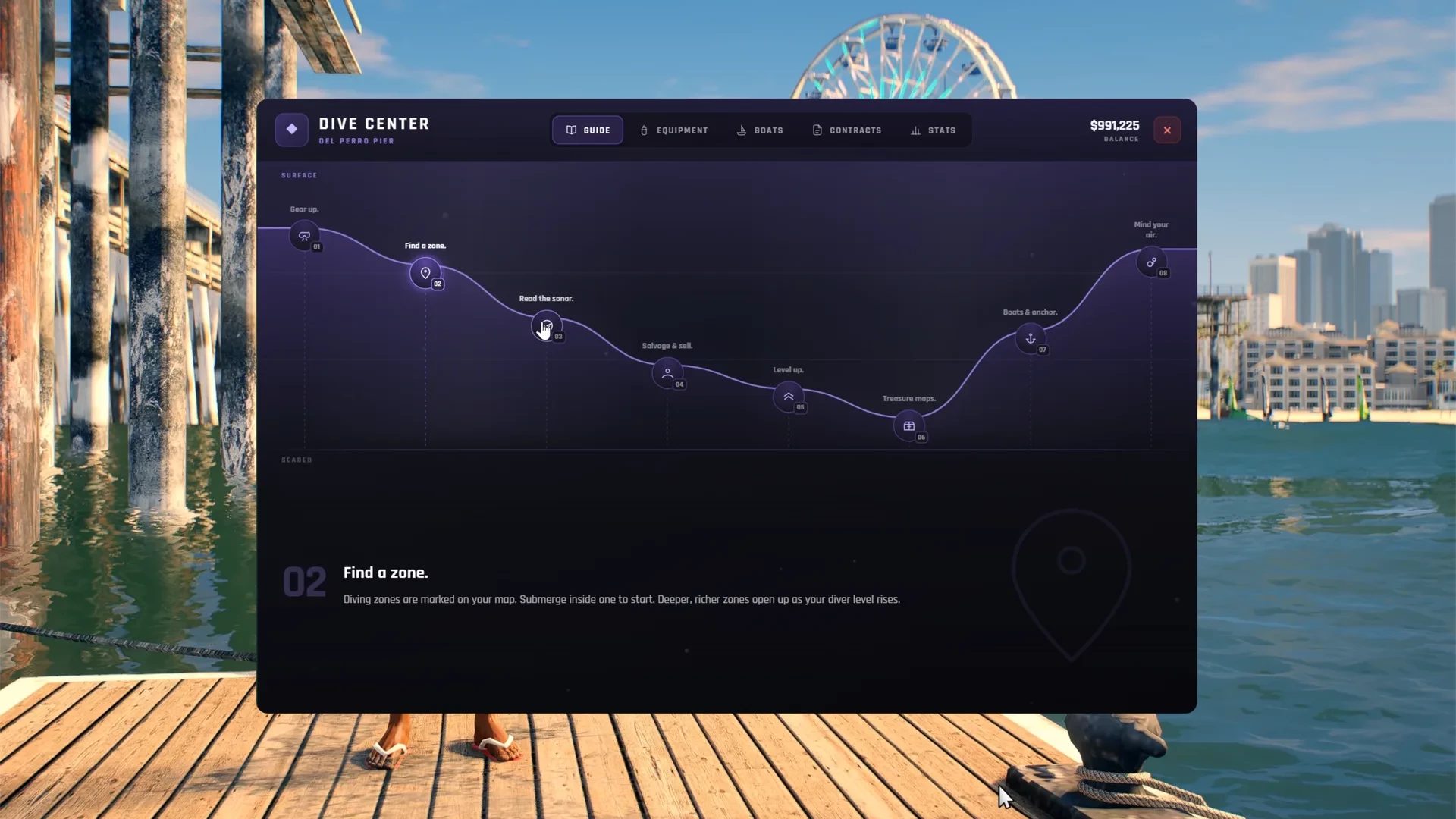
The Dive Center guide, showing the full diving loop

Equipment

Gear up for what's below.

The Dive Center gives players an equipment path that grows with them, from basic diving gear and oxygen tanks to improved lights and sonar.

Equipment isn't just a menu of purchases — it gives progression something tangible to unlock and changes what players can take with them beneath the surface.
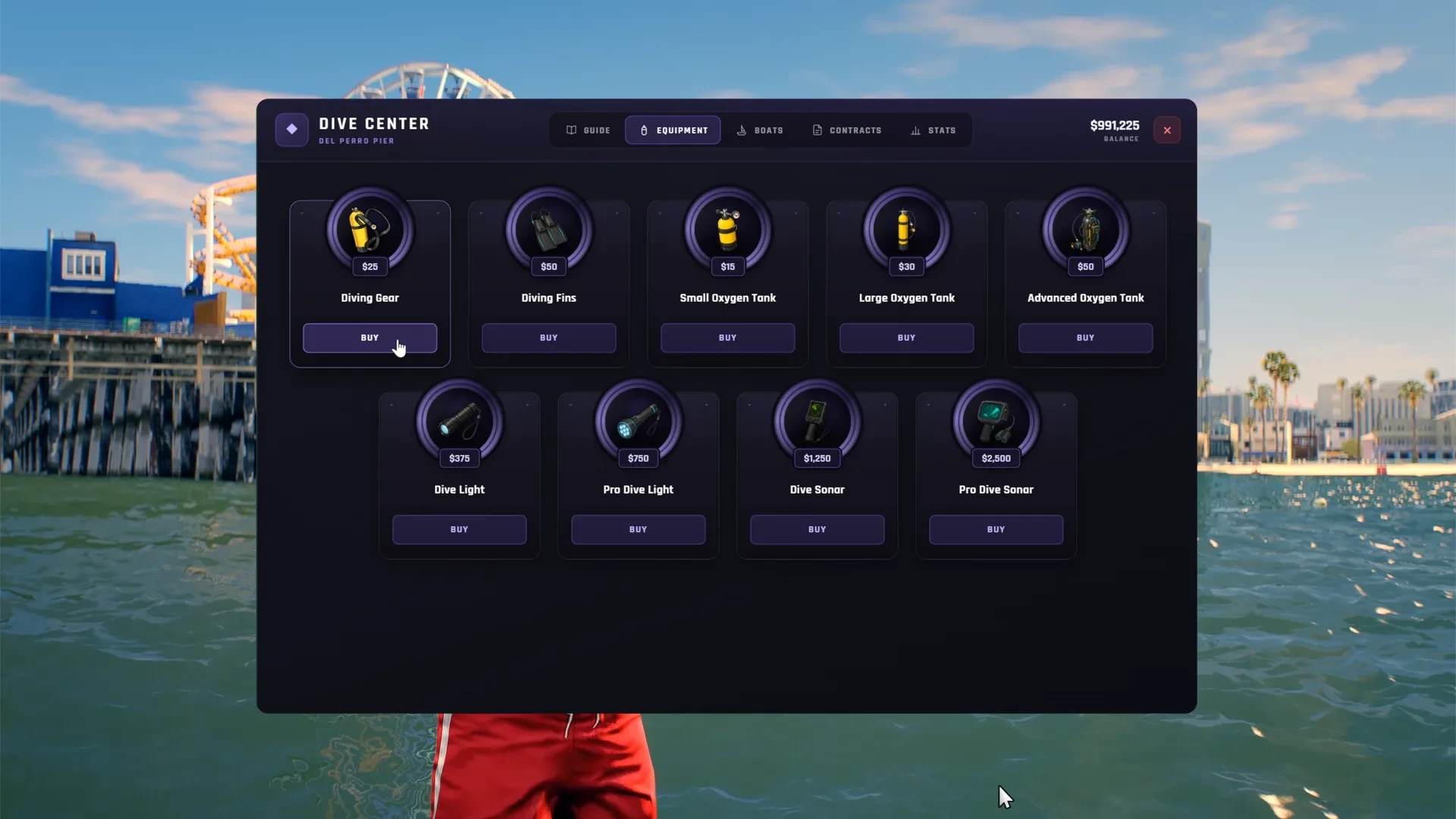
The equipment store, with tanks, lights and sonar

Boat hire

Take the dive further.

Players can rent from a range of boats before heading offshore, with different rental fees and deposits giving server owners another progression and economy lever.

Better access to the ocean becomes something players work towards rather than something handed to them from the start.
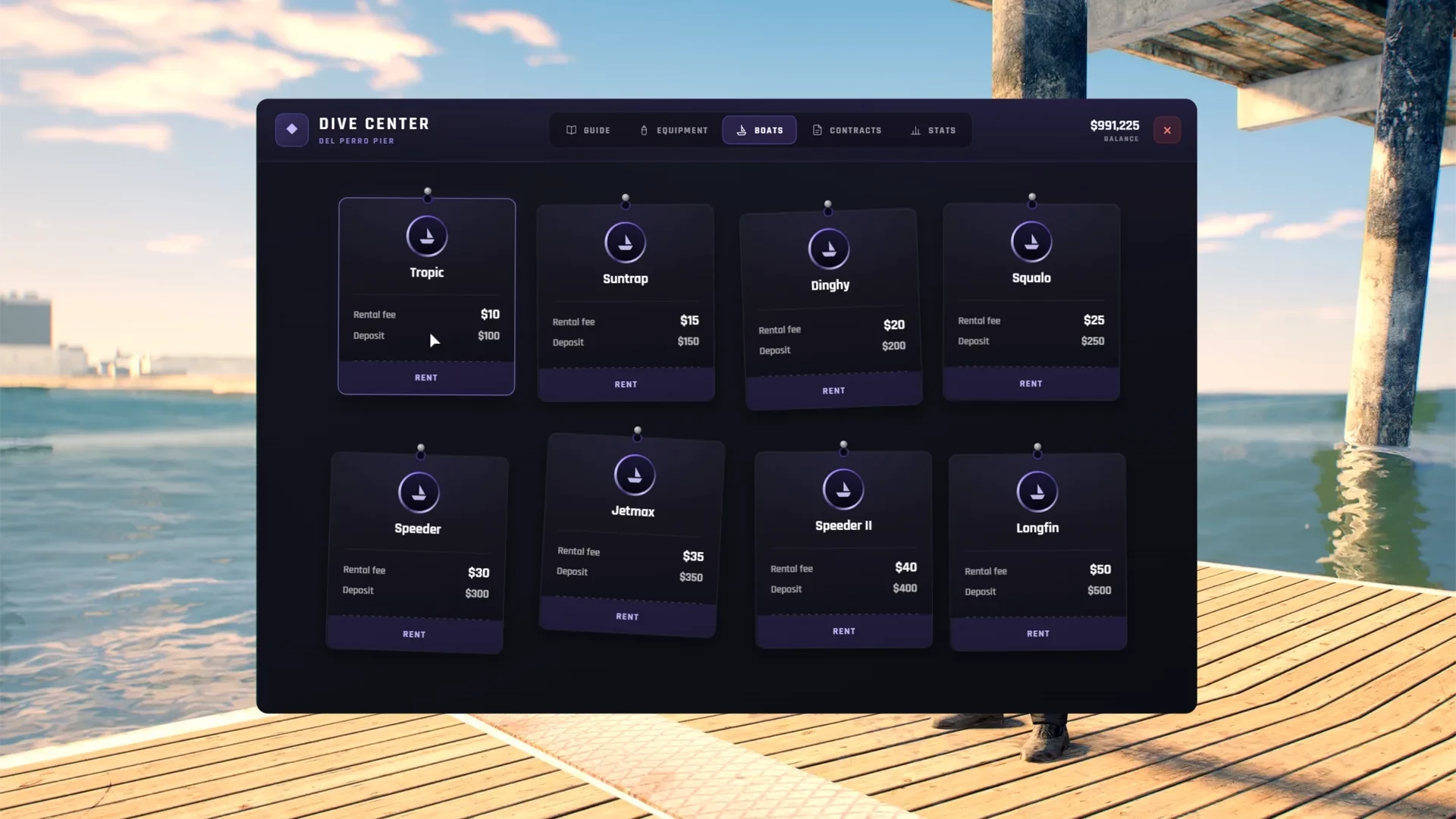
Boat hire, with rental fees and deposits

Contracts

Every dive can have a purpose.

Generated salvage contracts give players specific items to recover in return for cash and XP.

Players can take a job, track its requirements while they dive and deliver the requested haul — adding another reason to head back beneath the surface beyond simply searching for whatever they find.
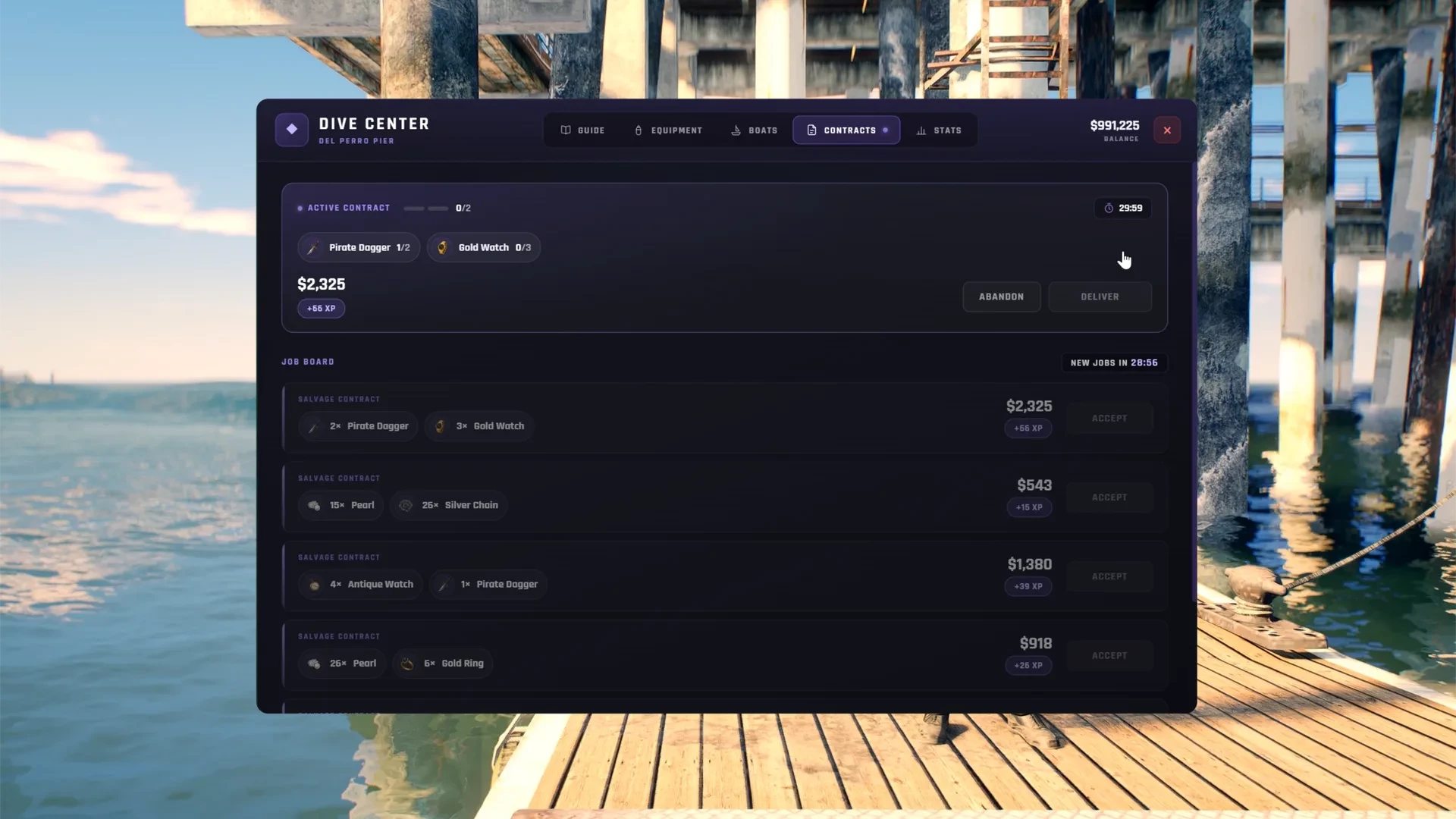
The contract board, with salvage jobs and rewards

Dealer

Turn every find into opportunity.

Salvage doesn't have to live on a fixed price list. Supply affects what the dealer will pay, while demand can create opportunities for particular finds to sell above their usual value.

What players bring back from the ocean therefore feeds into an economy that changes around their activity.
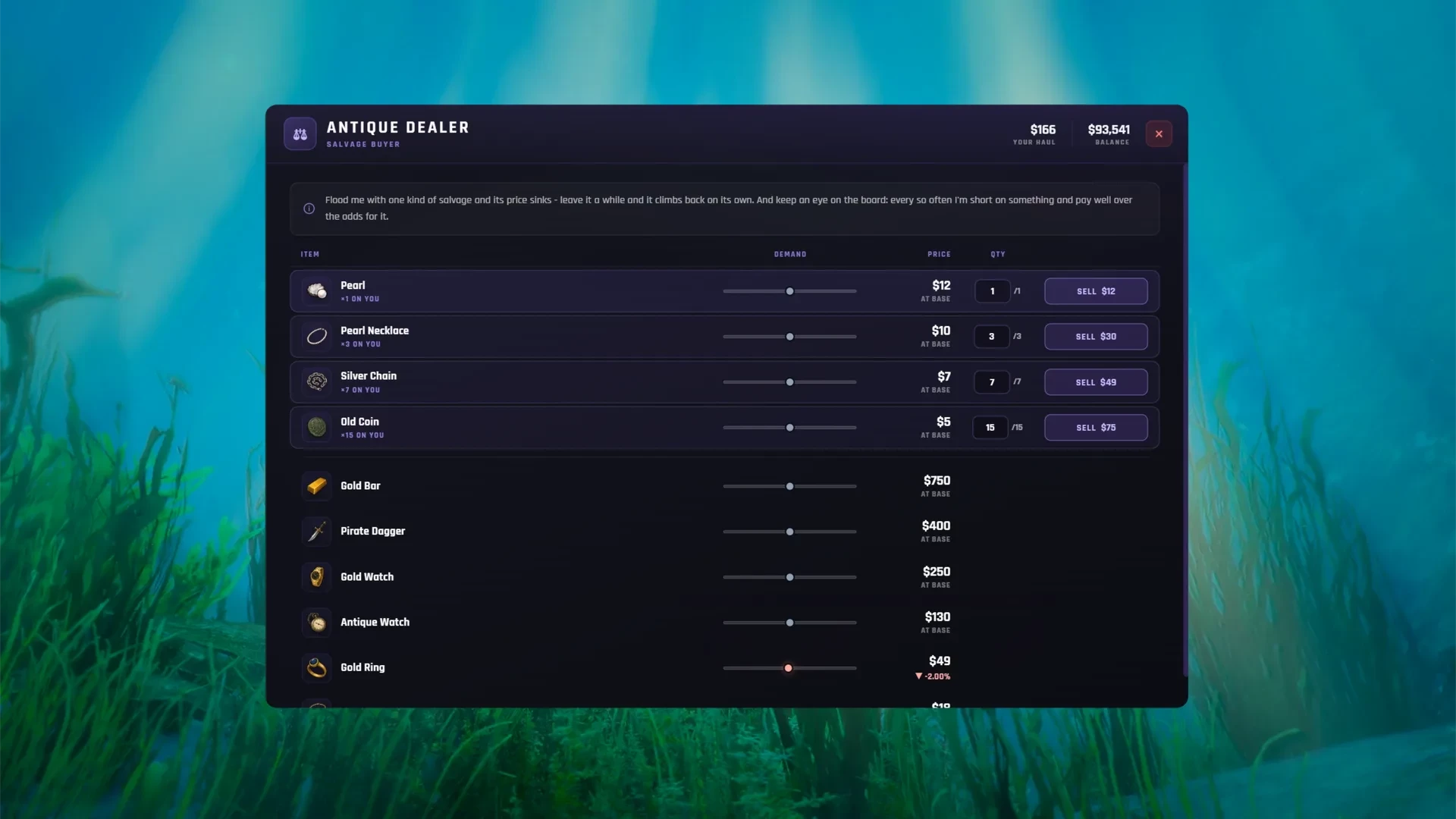
The salvage dealer, with supply and demand pricing

Stats

A career with a record.

Every trip contributes to a persistent diver profile. Level, XP, dives, time underwater, maximum depth, discoveries, treasure, earnings and completed contracts give players a record of what they've achieved.

The server-wide leaderboard gives them something to measure it against.
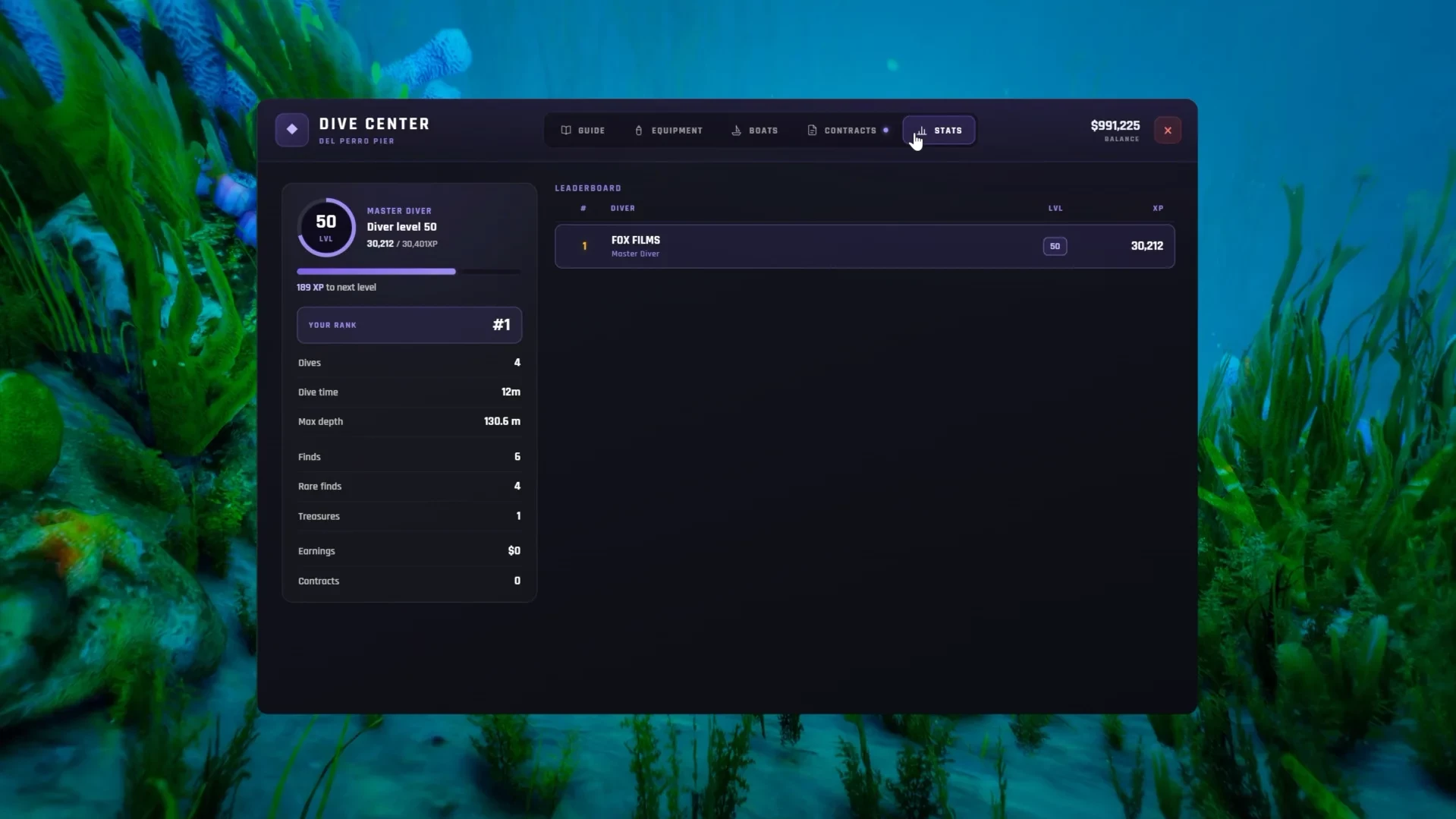
The diver profile and server leaderboard

Treasure

Treasure maps lead to something more.

Treasure maps give players locations to track down beneath the surface, leading them away from regular salvage in search of more valuable finds.

Reaching the location is only part of it — players still need to find and recover the treasure before they can bring it back.

A diver recovering treasure from the seabed

Decompression

Getting back up matters too.

Reaching the surface too quickly can trigger decompression sickness.

A rapid ascent causes escalating visual effects and player damage, making the journey back up something players need to manage rather than simply swimming straight to the surface.

Decompression sickness, shown as a rising red overlay

Sharks

You're not always alone down there.

Sharks can turn an otherwise routine dive into a fight for survival.

Players can defend themselves with melee weapons when attacked, forcing them to deal with the threat before getting back to exploring or recovering their haul.

A shark circling a dive site

Compatibility

Built to fit your stack.

Diving supports multiple frameworks, inventories and interaction systems through its bridge layer, with standalone interaction support where a target resource is not used.

Frameworks
qb-coreqbx_corees_extendedox_coreND_Core
Inventories
ox_inventoryqb-inventoryqs-inventorytgiann-inventorycodem-inventory
Target systems
ox_targetqb-targetstandalone
Database
oxmysql
Library
ox_lib

View full compatibility documentation

£19.99

Arenas

A complete PvP arena system built around competitive combat, rankings and persistent progression.

Showcase

Step out of RP. Not out of the server.

Arenas gives players somewhere to fight, compete and climb without leaving the server they already play on.

Matches take place in isolated worlds, keeping competitive combat contained while rankings, records and progression give players a reason to come back.

Game modes

Three ways to fight.

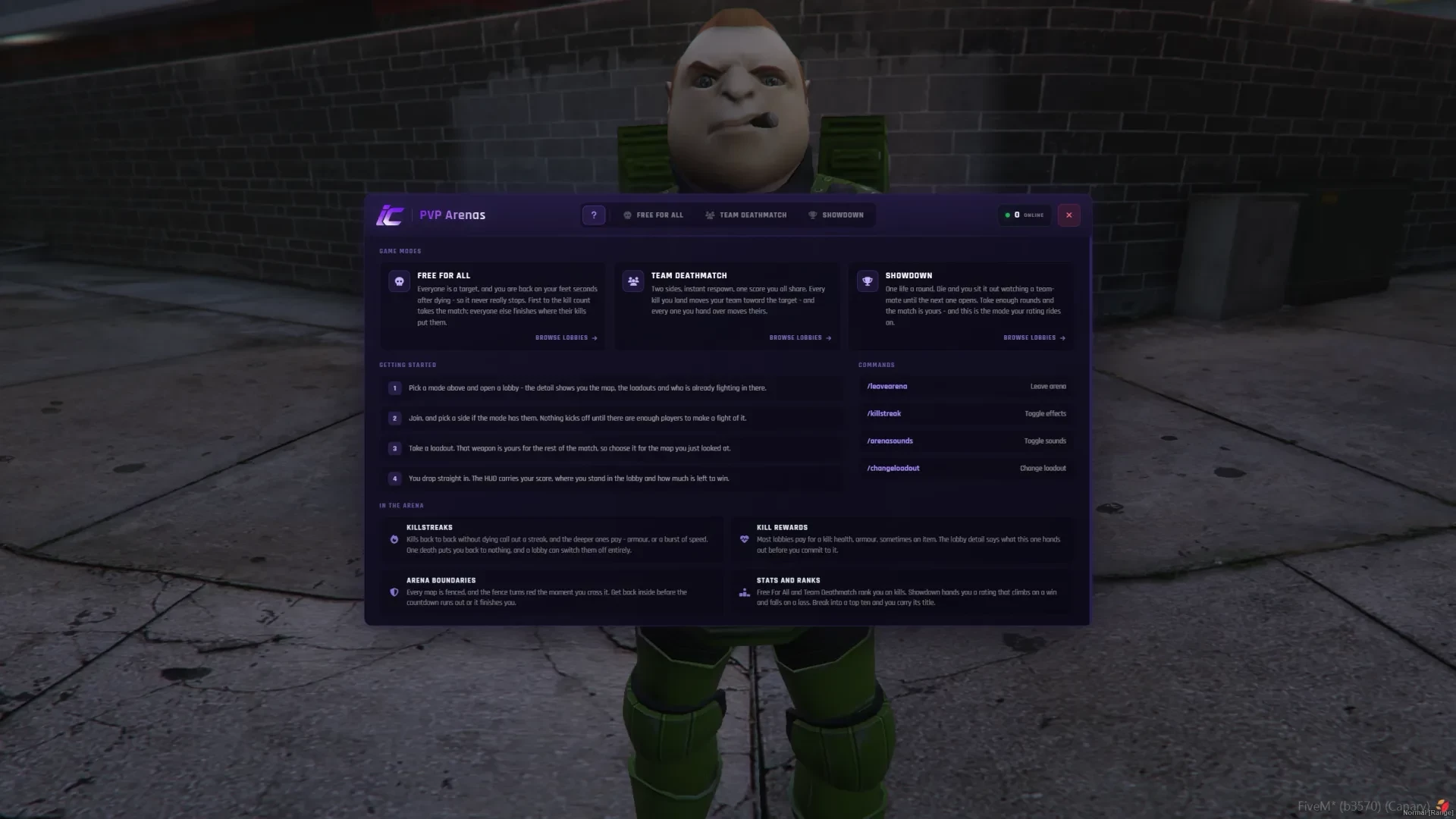
Free For All keeps the fight moving with constant respawns and an individual kill target. Team Deathmatch turns every kill into a shared score. Showdown changes the pace completely with one-life rounds and ranked ELO.

Three modes built around different kinds of competition, rather than the same fight wearing a different name.

The Arenas mode selection screen

Lobbies

Know the fight before you join it.

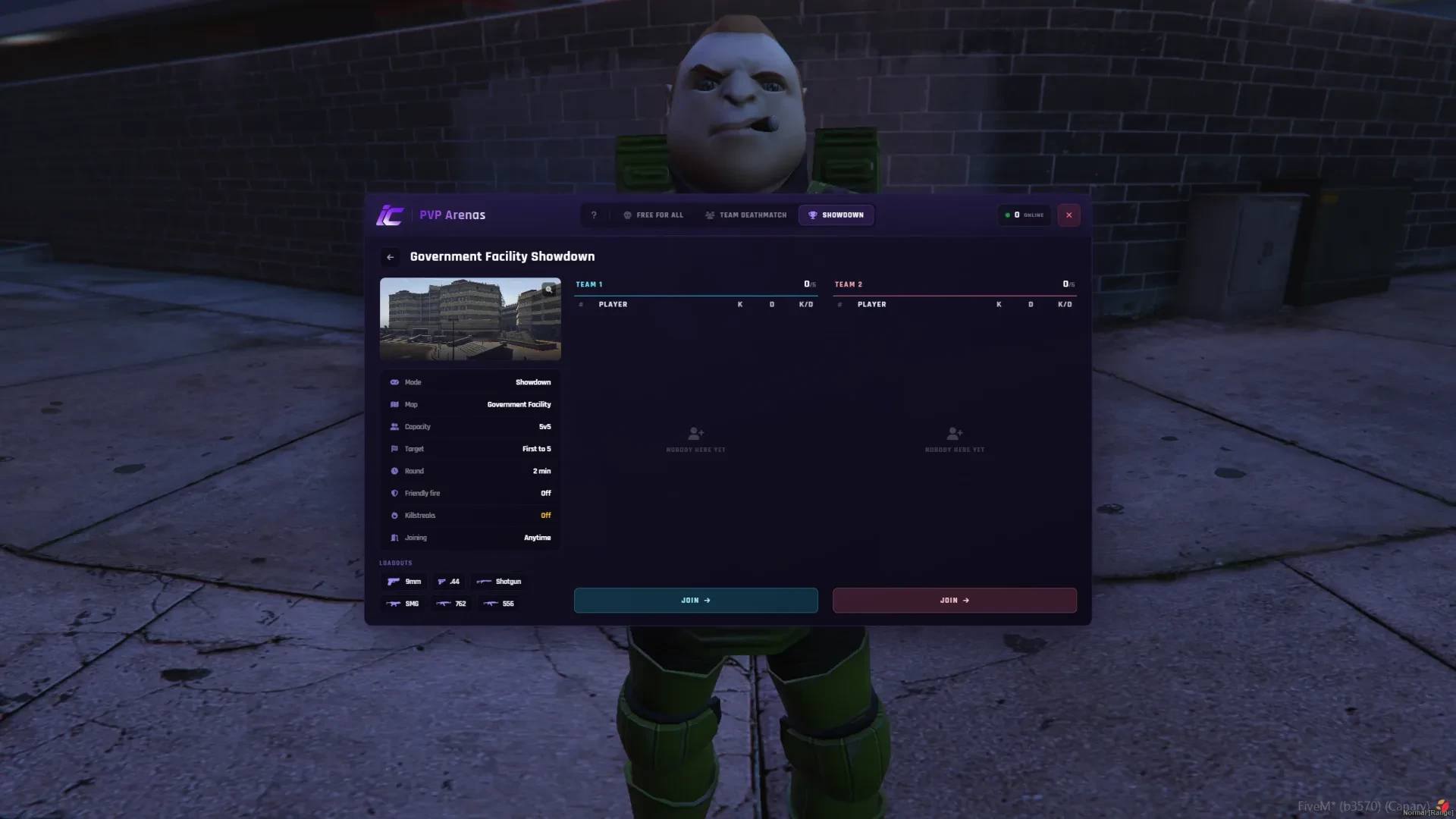
Players can browse every available arena before committing, with live activity showing where the action already is. Open a lobby to see the map, available loadouts, rules and the fight currently taking place.

Joining an arena becomes a choice, not a blind teleport.

An arena lobby showing the map, rules and teams

Loadouts

Pick your role. Then prove it.

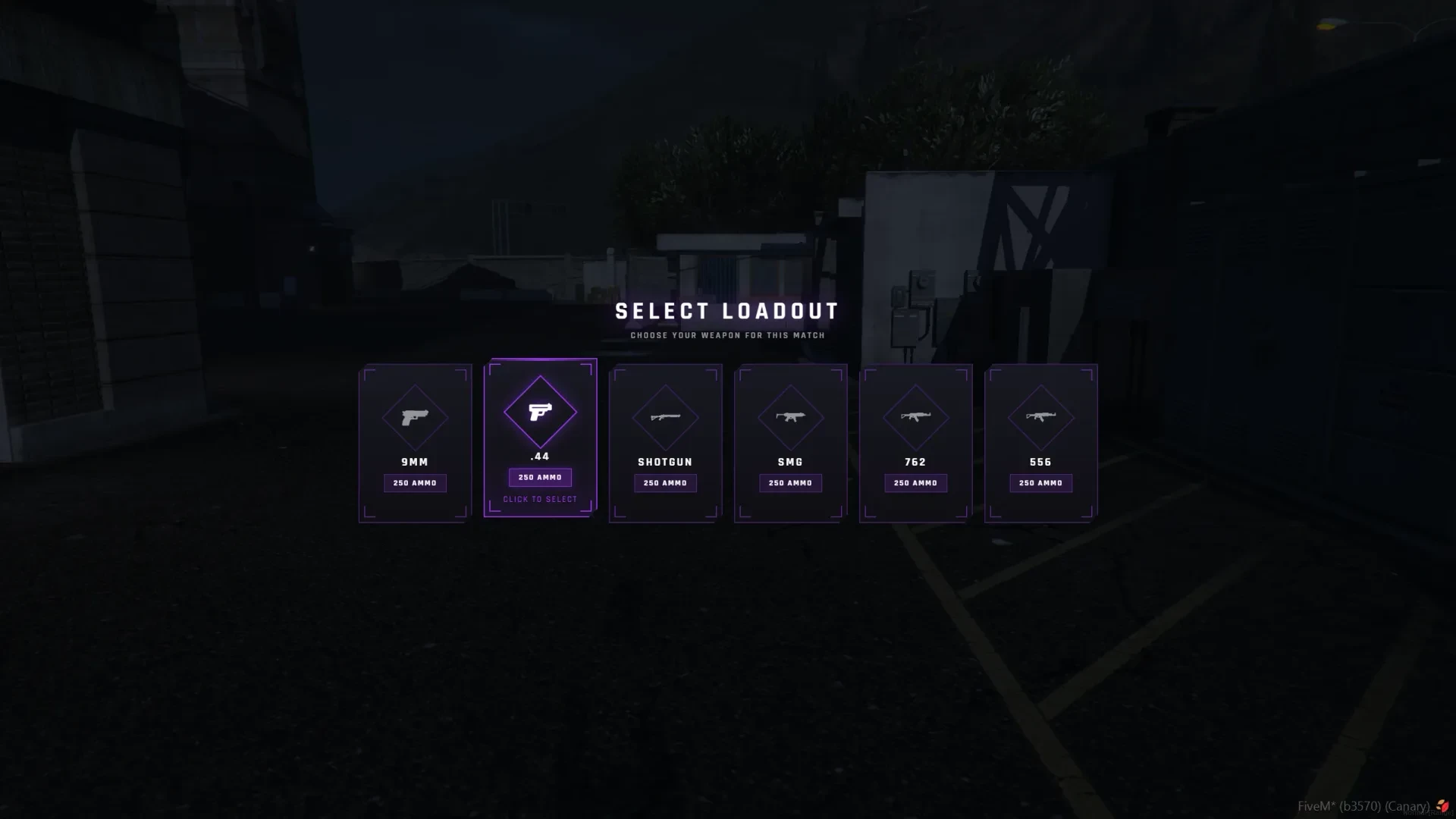
Every arena defines the weapons players can take into the fight. Players choose their loadout before spawning, keeping the arsenal deliberate and allowing each arena to create its own style of combat.

Different maps can demand different choices without giving players unrestricted access to weapons.

The loadout selection screen before spawning

Showdown

One life changes everything.

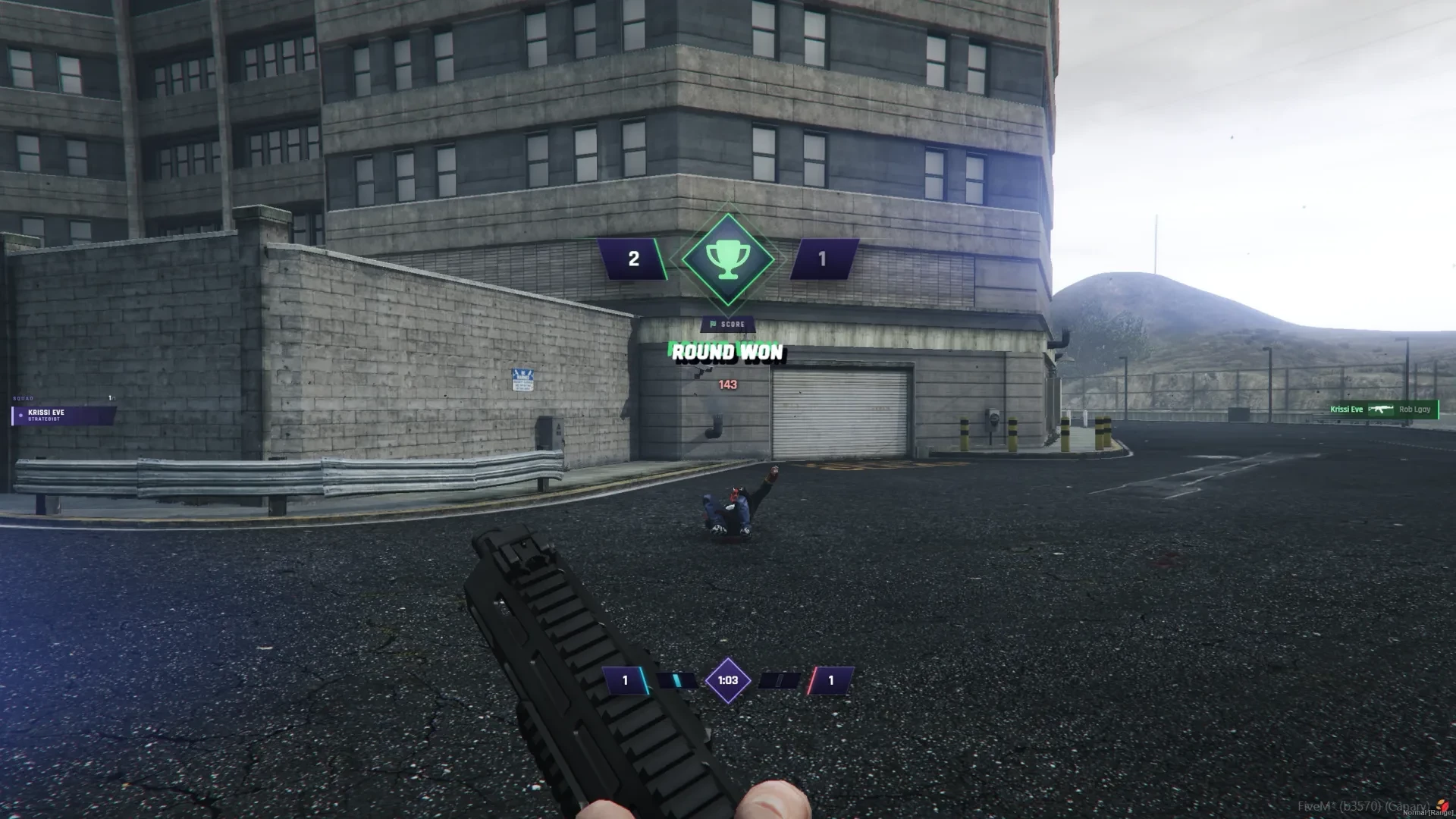
Showdown trades constant respawns for round-based combat. Die and you sit the round out watching a team-mate. Take enough rounds and the match is yours.

This is where ELO matters. Wins move players upward, losses move them back down, and leaving mid-match counts as a concession.

A Showdown round won, with the round score above the arena

Combat feedback

Every kill should feel like one.

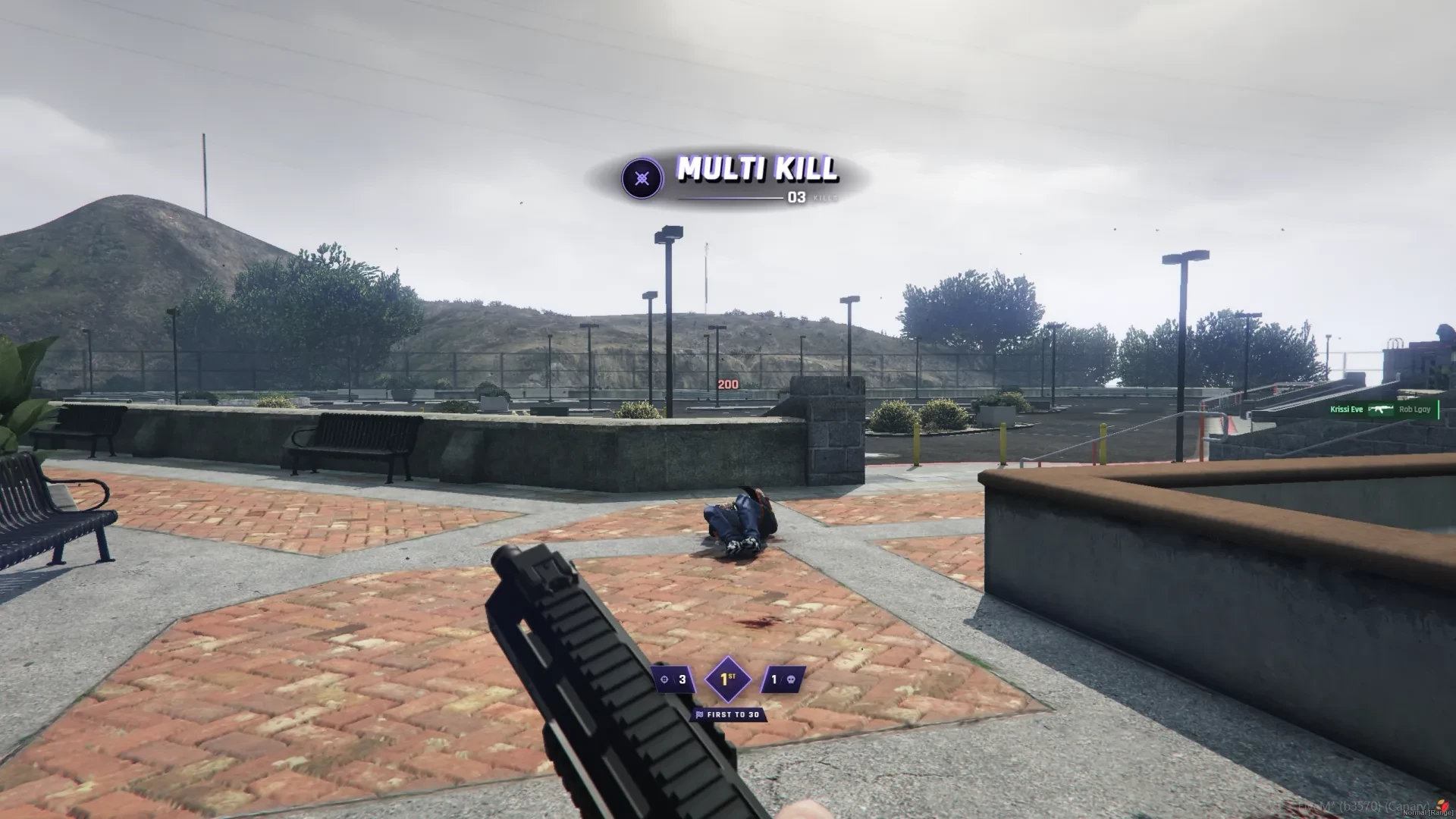
Live scores, killfeed, hit markers, headshot feedback and escalating killstreak callouts keep the player informed without pulling attention away from the fight.

Killstreaks build from DOUBLE KILL through to GODLIKE, with deeper runs able to reward the player — until one death puts the streak back to zero.

A killstreak callout during a match

Progression

Every match leaves a record.

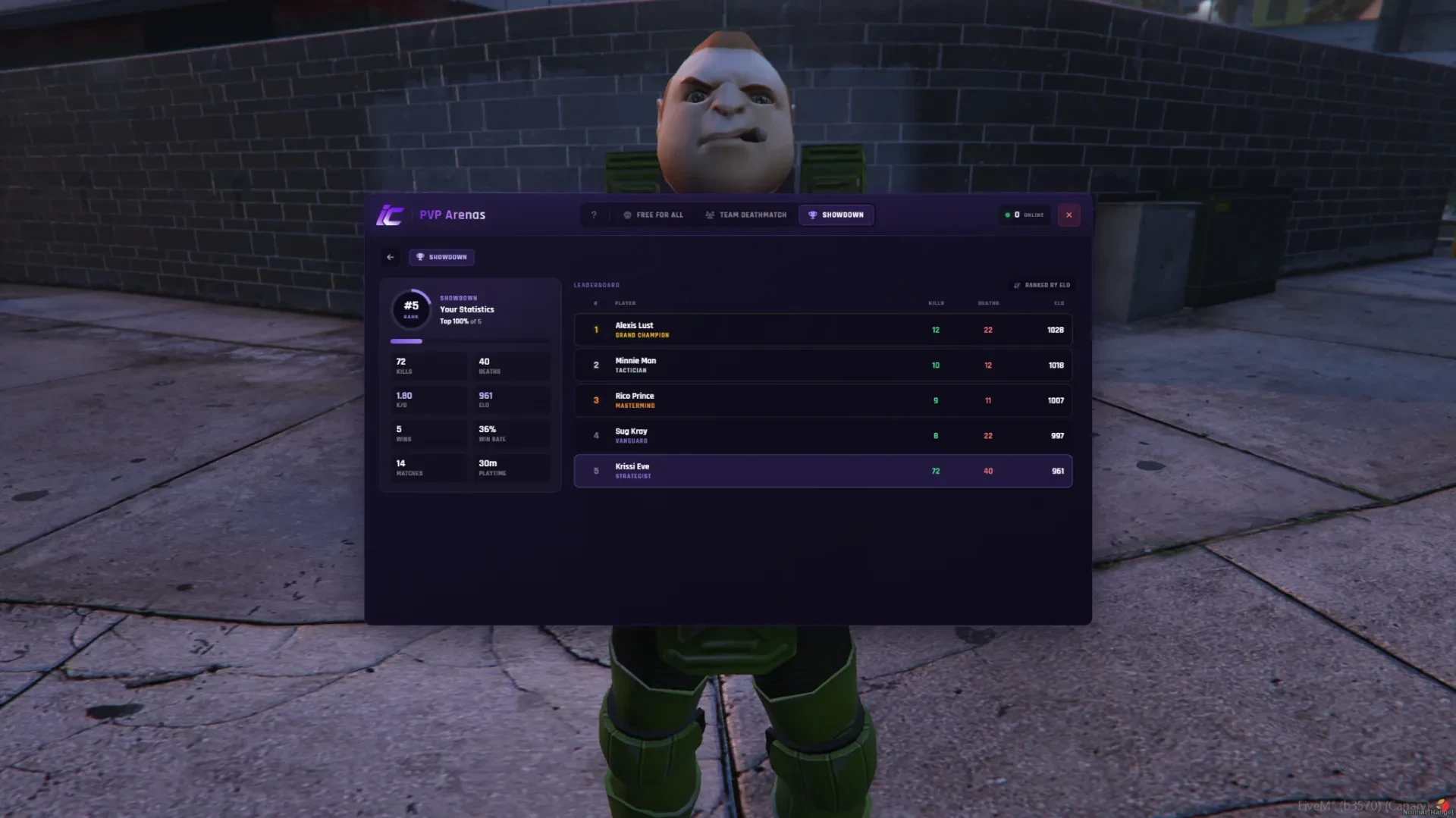
Kills, deaths, K/D, wins, matches and playtime persist beyond the fight, tracked separately for each mode.

Showdown adds ELO-based ranking, while mode-specific leaderboards and earned titles give players something visible to climb towards. A finished match is not the end of the system — it becomes part of the player's competitive record.

The Arenas leaderboard and personal statistics panel

Compatibility

Built to fit your stack.

Arenas runs on every major framework through its bridge layer and works with the inventory, target and voice resources a server already has. Ambulance integrations and the full option list are covered in the documentation.

Frameworks
qb-coreqbx_corees_extendedox_coreND_Core
Works with
ox_inventoryqb-inventoryqs-inventorytgiann-inventorycodem-inventoryox_targetqb-targetpma-voice
Required
ox_liboxmysql

View full compatibility documentation

£29.99

Money Wash

A complete laundering process built around nightlife, contacts, cash collection and hands-on counting.

Showcase

More than clean cash.

Money Wash turns dirty cash into a complete laundering loop. Players make it rain at the club, track their money through the trap phone, wait for a contact and collect the cash before counting it by hand.

Tax, progression and changing contacts sit behind the process, turning what is usually a single interaction into an activity players actually perform from start to finish.

Money rain

Turn dirty money into part of the scene.

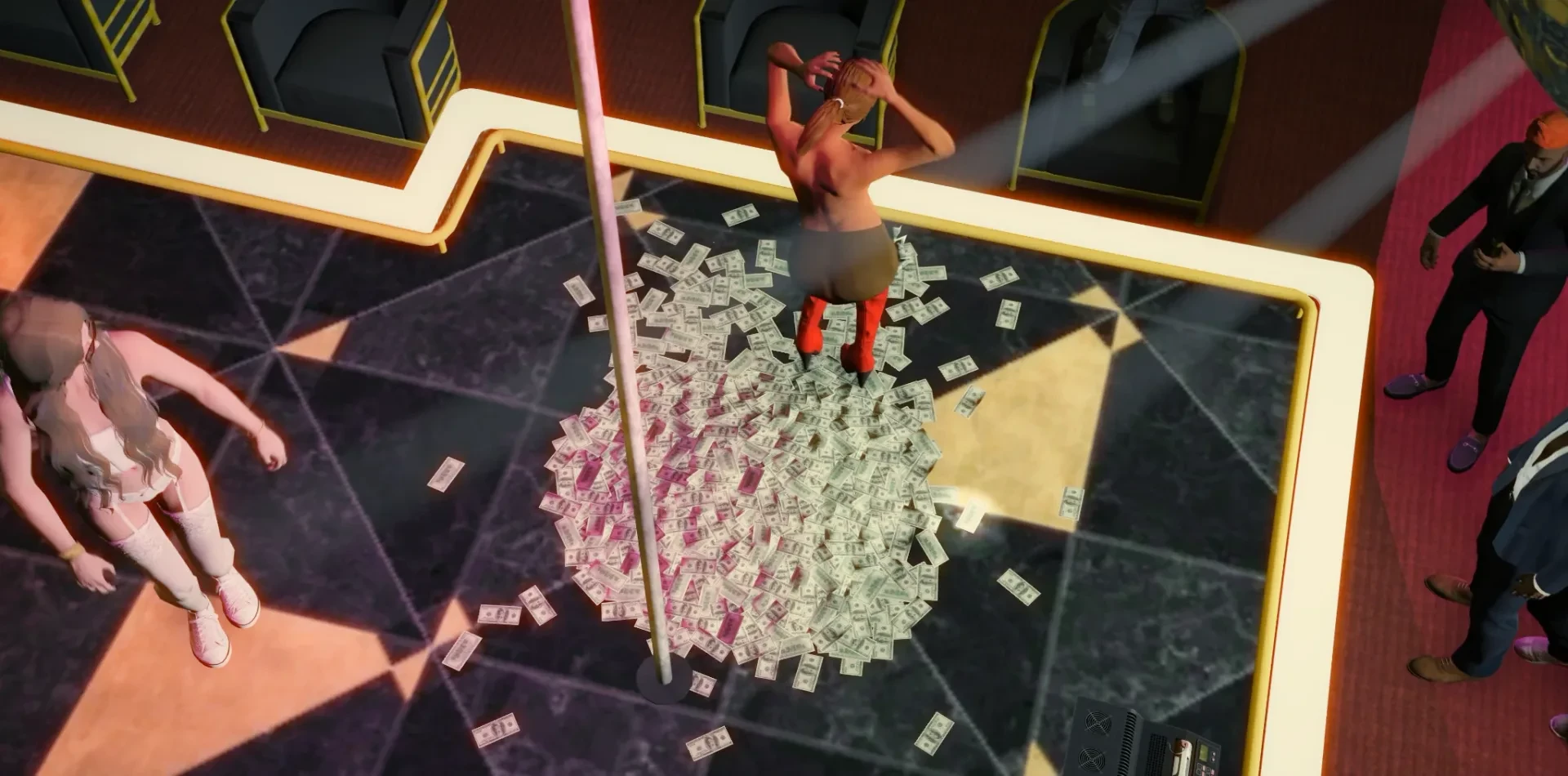
Players begin the wash by spending dirty money inside the strip club rather than handing it to a marker. As more money moves through the room, visible cash builds around the stage, making the amount being laundered part of the environment itself.

The thresholds, money amounts, props and reset behaviour are configurable, letting servers tune the mechanic around their own economy.

Cash building up around the strip club stage

Trap phone

Keep the operation in your pocket.

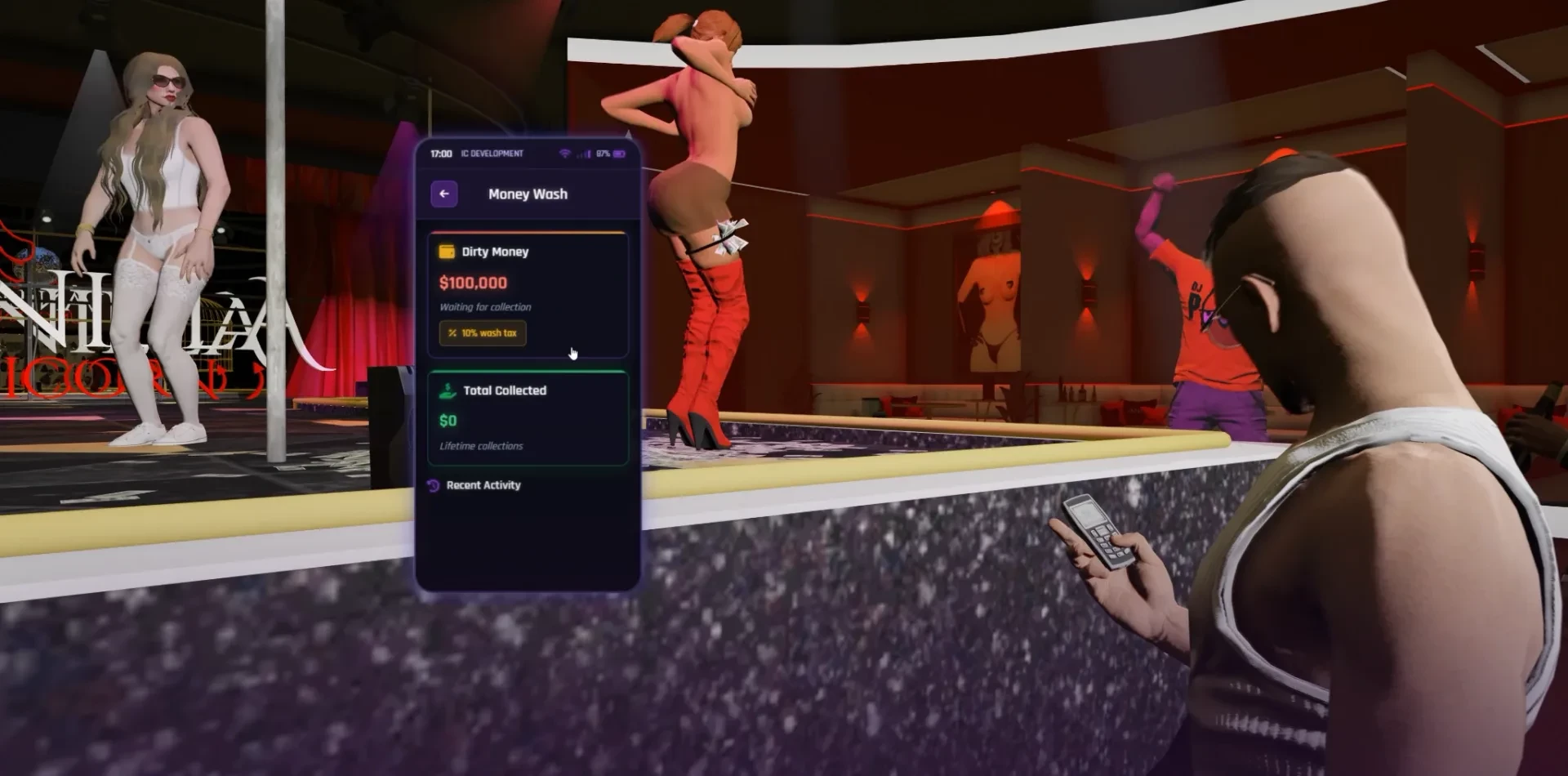
The trap phone keeps the player connected to the wash once the money has been put into the system. Pending money, current tax and lifetime collections are surfaced through the interface so players can see where they stand before arranging the next step.

As lifetime collections grow, the tax rate can decrease, giving repeated use of the system a progression layer rather than making every wash identical.

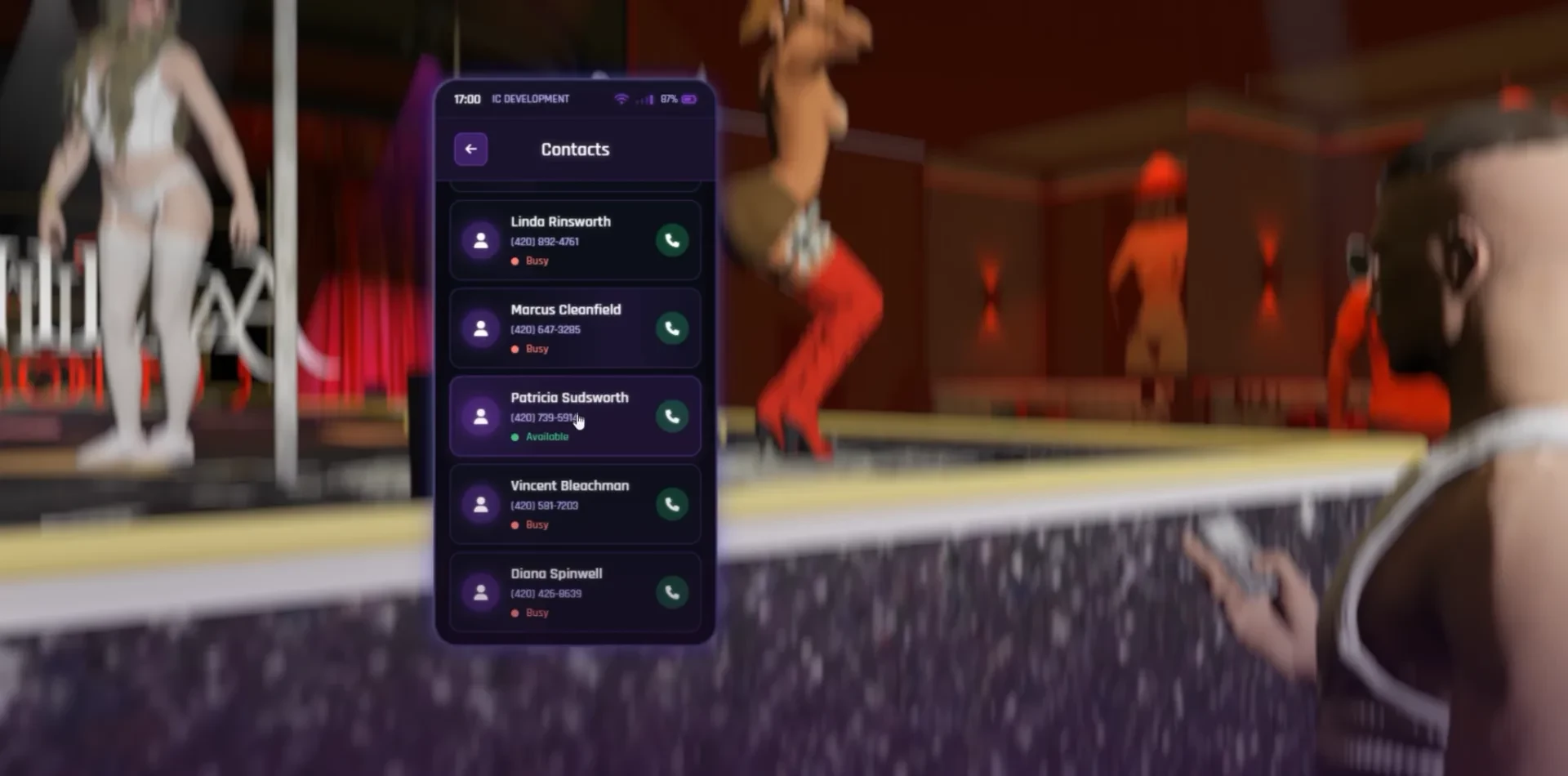
The trap phone showing pending dirty money and the wash tax

Contacts

Someone has to move the money.

Players use the trap phone to reach the contact network responsible for arranging collection. Available contacts are surfaced through the phone, turning the next stage of the wash into an interaction with the underground network rather than another static waypoint.

Contact locations and the wider handoff system can be configured to fit the server around it.

The contact list on the trap phone

Collection

Pick up what’s waiting for you.

Once the handoff is arranged, the player heads out to meet the contact and collect the processed money as a cash bag. The pickup takes the laundering loop away from the nightclub and gives the operation another physical step before the money can finally be cleaned.

Contact locations are configurable, so servers can decide where these exchanges belong in their world.

Meeting a contact to collect the cash bag

Counting

Finish the wash by hand.

Cash bags still have to be processed before the player receives clean money. At the counting location, the contents are worked through in chunks using the counting interaction rather than converting the entire bag instantly.

Larger amounts take longer to process, while chunk size, payout behaviour and the final clean-money output can be configured around the server’s economy.

Counting the contents of a cash bag into clean money

Compatibility

Built to fit your stack.

Money Wash runs on every major framework through its bridge layer and works with the inventory and target resources a server already has, including standalone interaction where no target system is used. Installation, item definitions and configuration are covered in the documentation.

Frameworks
qb-coreqbx_corees_extendedND_Core
Inventories
ox_inventoryqb-inventoryes_extendedqs-inventoryps-inventorytgiann-inventorycodem-inventorycore_inventory
Target systems
ox_targetqb-targetstandalone
Database
oxmysql
Required
ic_libox_lib

View full compatibility documentation

£29.99

Pawnshop

A living pawn shop and fence system with dynamic prices, reputation, buy-back stock and a hidden black market.

Market

Every sale changes what comes next.

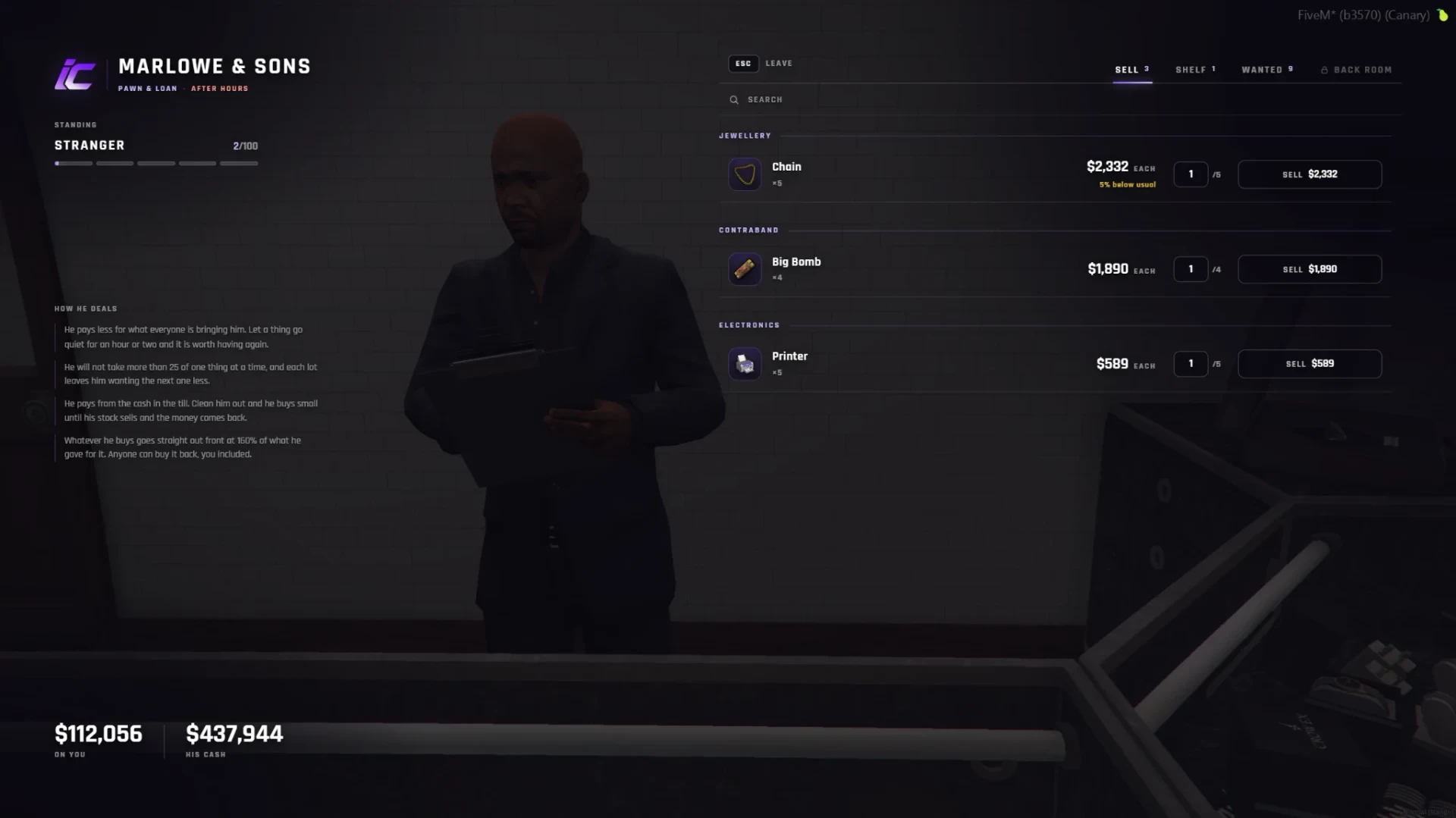
The fence does not buy from a fixed price list. What players sell affects what those items are worth across the server, with prices dropping as supply builds and recovering again over real time.

Standing changes what an individual player is paid, while each branch has its own finite cash float — so the shop behaves like an economy rather than an unlimited sell point.

The sell counter, with an item priced below its usual value after heavy supply

Shelf

What comes in goes back out.

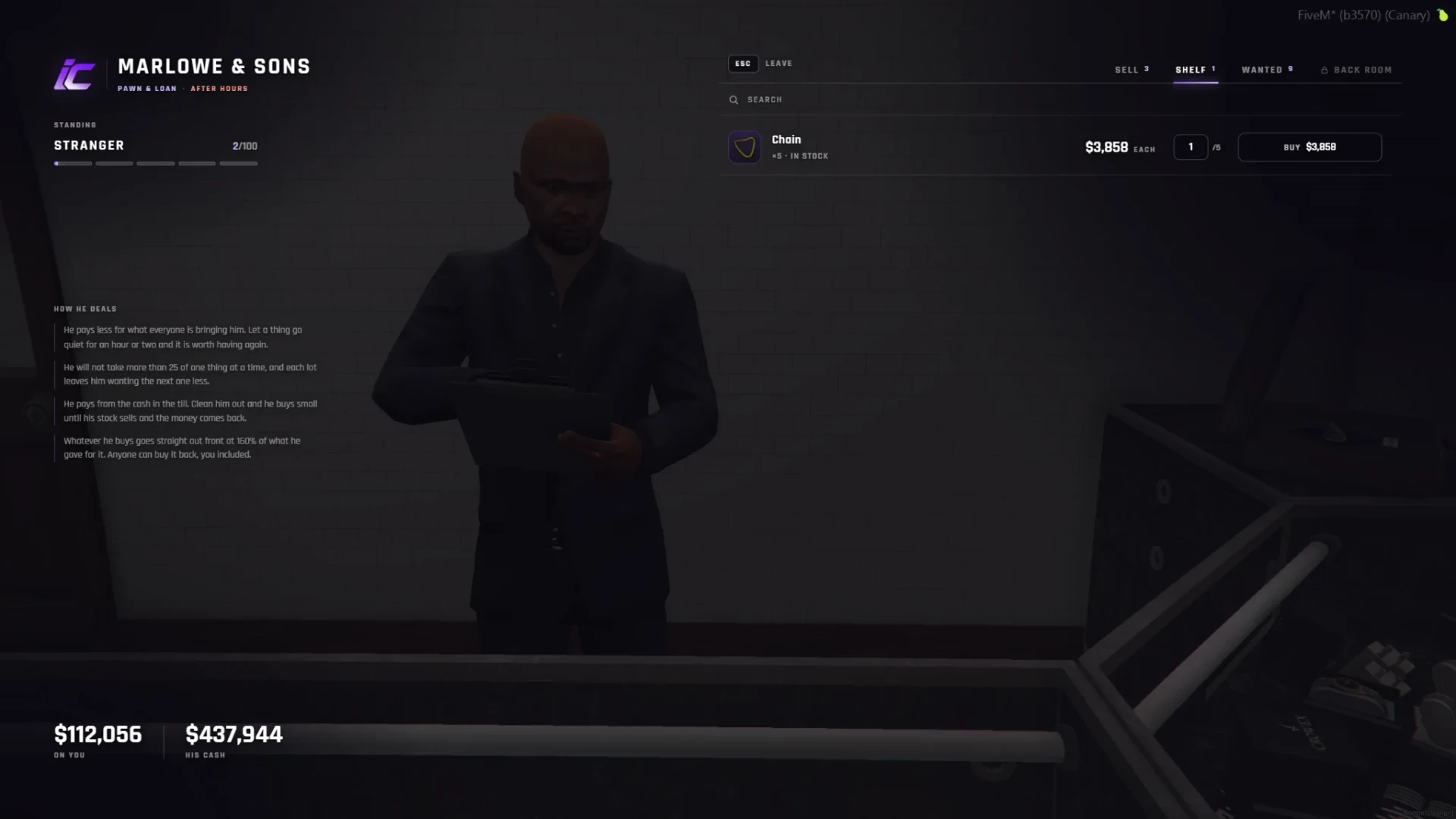
Everything the fence buys can move straight onto the public shelf, where anyone can buy it back — including the player who originally sold it.

Stock leaves the shelf over time as the fence makes his own sales, feeding money back into the branch and helping its cash float recover naturally through trade.

The public shelf, showing stock the fence has bought back in

Specialties

Some things are worth taking elsewhere.

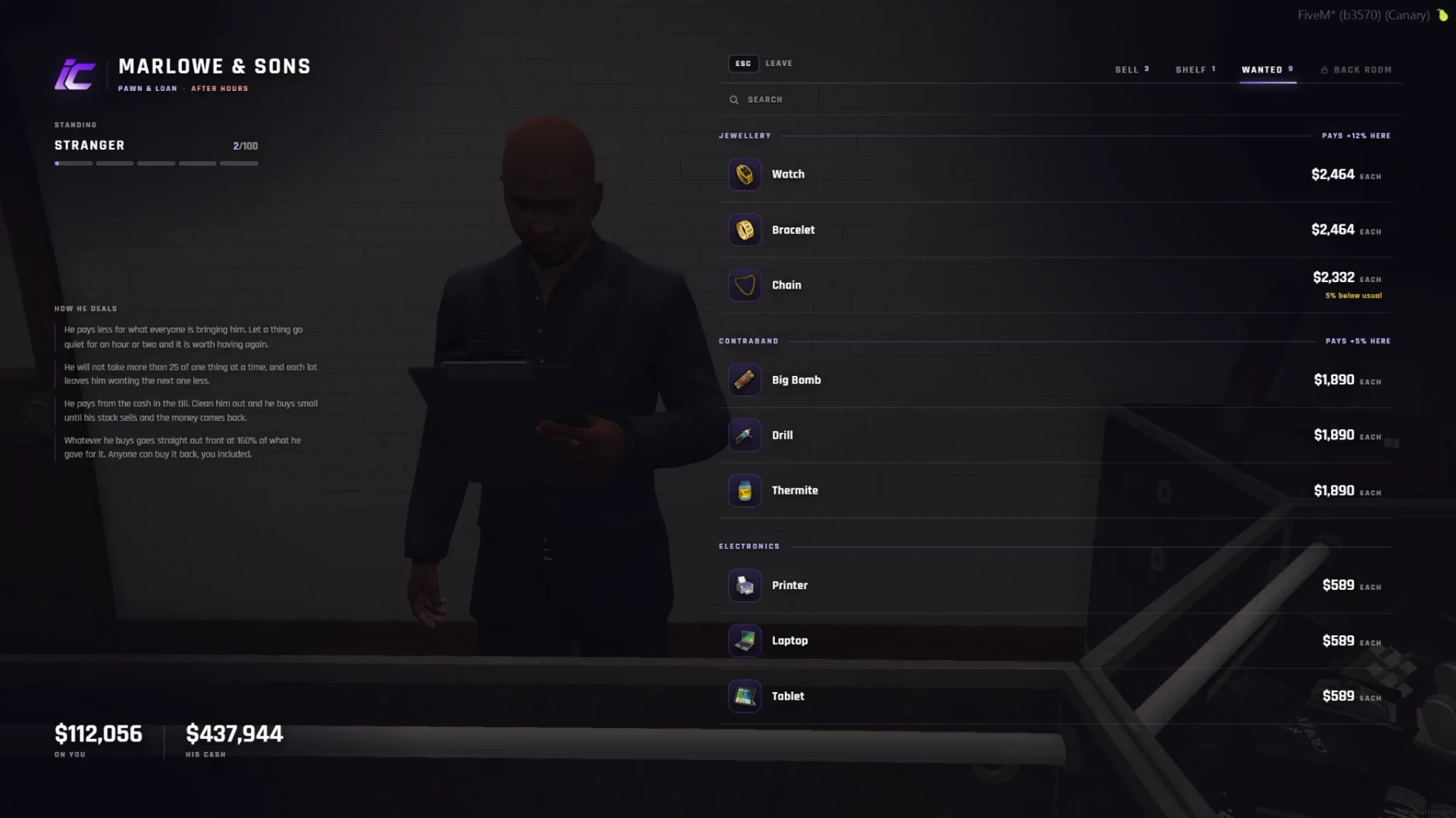
The Wanted view shows what the branch deals in and what those goods are currently worth. Branch specialties can push entire categories above or below the usual market price, giving players a reason to decide where they sell rather than always visiting the nearest counter.

Individual branches can also refuse categories or specific items, while contraband can be restricted to after-hours trading.

The Wanted list, with branch specialties raising the price of whole categories

Standing

Trust is earned over the counter.

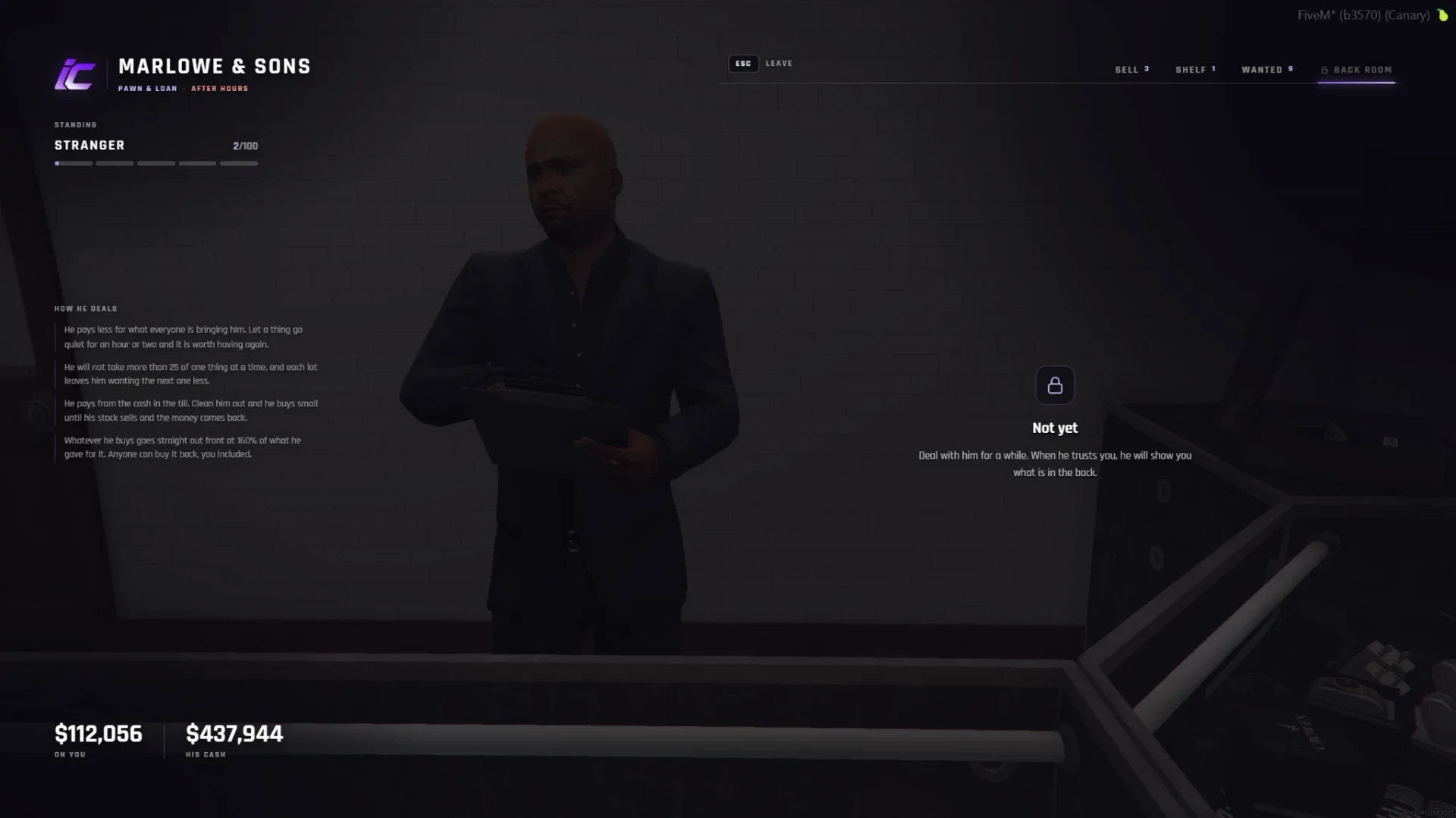
Every successful sale builds standing with the fence. Higher tiers improve the player’s payout and eventually reveal parts of the business that strangers never get to see.

Standing only increases through actual selling, tying progression directly to how much business the player has done rather than giving them another stat to farm separately.

A player still at stranger standing, with the back room locked

Back room

The better stock stays out of sight.

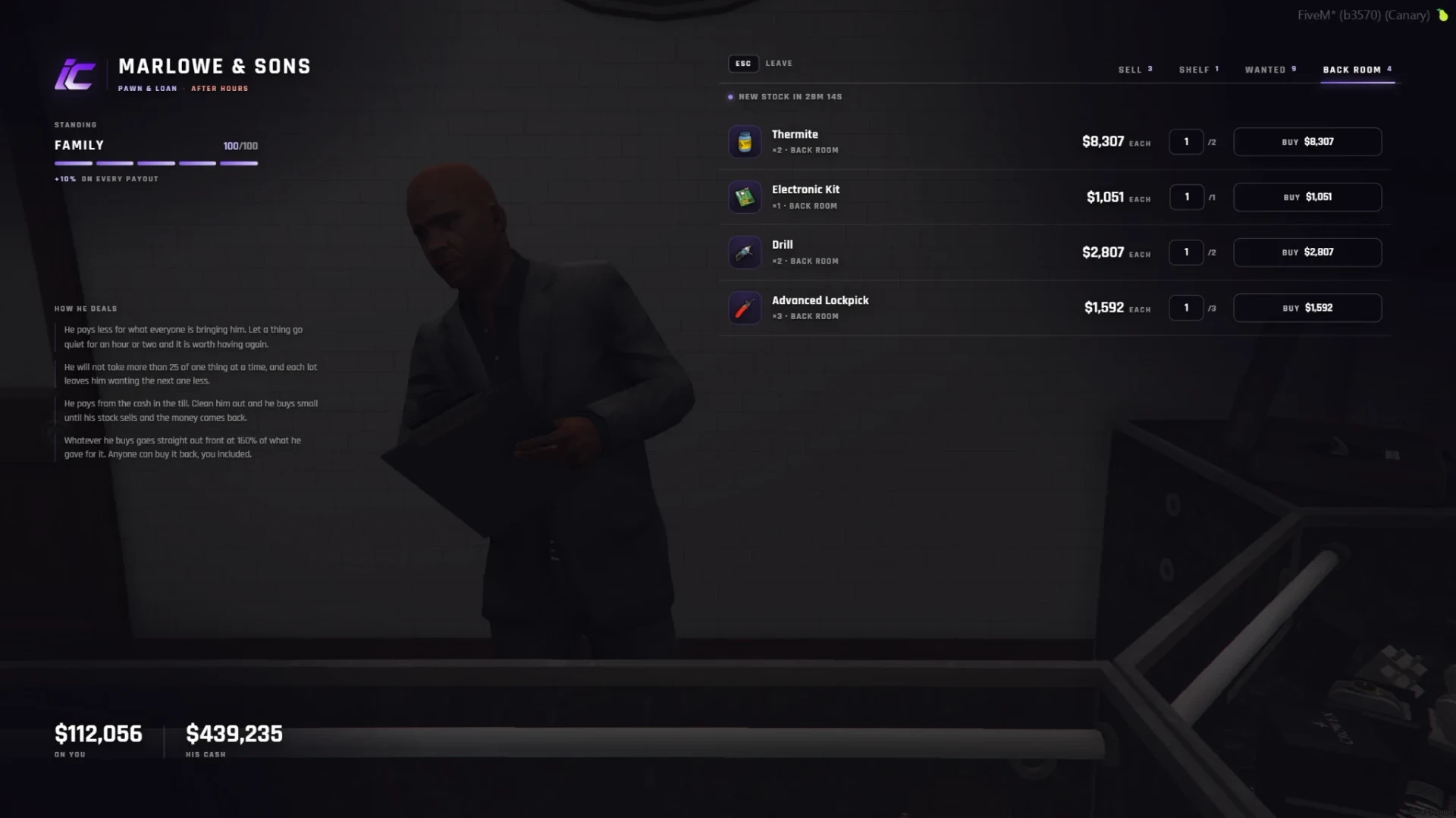
Build enough standing and the fence opens access to his hidden stock. Each branch can have its own selection, pricing, slot count and restock interval, with a live countdown showing when something new is due to arrive.

Different branches can carry completely different back rooms, turning reputation into access rather than simply another payout bonus.

The back room stock list, unlocked at family standing

Compatibility

Built to fit your stack.

Pawnshop runs on every major framework through its bridge layer and works with the inventory and target resources a server already has, with standalone interaction where no target system is used. Installation and configuration are covered in the documentation.

Frameworks
qb-coreqbx_corees_extendedox_coreND_Core
Inventories
ox_inventoryqb-inventoryqs-inventorytgiann-inventorycodem-inventory
Target systems
ox_targetqb-targetstandalone
Database
oxmysql
Library
ox_lib

View full compatibility documentation

£14.99